The short answer
- Arkansas homes don't need Northern-grade winterizing, but pipes in crawl spaces, garages, and exterior walls still freeze most winters — usually during a hard freeze in the teens or lower.
- The fall checklist: insulate exposed pipes, disconnect and drain outdoor hoses, know your main shutoff location, let faucets drip during a hard freeze, and seal crawl space vents.
- Most of this is a weekend afternoon of work with foam pipe sleeves, hose bibb covers, and some weatherstripping — no contractor required for the basics.
- If a pipe does freeze or burst, shutting off the main valve fast is what limits the damage — Bowen Plumbing handles frozen and burst pipe repair across Hot Springs, Hot Springs Village, Malvern, Bismarck, Jessieville, Pearcy, and Royal.
Arkansas winters are mild compared to most of the country, which is exactly why so many homes here get caught off guard. A hard freeze doesn't come every week like it does further north — so pipes, hose bibbs, and crawl spaces that would be automatically protected in a colder climate often aren't protected at all here.
The good news is that winterizing a typical Hot Springs-area home is a short list of tasks, not a major project. Done in the fall, before the first real cold snap, it takes an afternoon and a modest amount of hardware from any hardware store. Here's what actually matters, in the order it's worth doing it.
Why Do Pipes Freeze in Arkansas If Winters Are Mild?
Pipes freeze in Arkansas when temperatures drop into the low 20s or teens for several hours, which happens most winters even though it's not the norm, according to the National Weather Service, which tracks Arkansas hard-freeze events by county each season. Uninsulated pipes are the ones at risk.
The pipes that fail aren't usually the ones inside heated living space — they're the ones running through crawl spaces, unheated garages, exterior walls, or under mobile homes, where there's little or no ambient heat to keep water above freezing. A pipe doesn't need days of cold to burst; one hard overnight freeze is often enough.
That's the core issue with Arkansas winterizing: because hard freezes are irregular rather than constant, it's easy to assume a mild winter means no risk. One cold snap a season is all it takes for an unprotected pipe to split.
The Fall Pipe Winterizing Checklist for Arkansas Homes
This is the order we'd walk a Hot Springs homeowner through, from easiest to do first to the ones worth thinking through before a freeze actually hits. None of it requires special tools.
- Insulate exposed pipes — wrap any pipe running through a crawl space, unheated garage, attic, or exterior wall with foam pipe sleeves or heat tape, paying particular attention to the section closest to an outside wall.
- Disconnect and drain outdoor hoses — remove every garden hose from its spigot, drain it fully, and store it; a hose left attached traps water in the spigot itself and is one of the most common freeze points on a property.
- Install hose bibb covers — slip an insulated foam cover over each outdoor spigot after the hose is off; they cost only a few dollars each and give real protection on their own.
- Know where your main water shutoff is — locate it now, make sure the valve actually turns, and tell everyone in the household where it is and how to use it before you need it in a hurry.
- Let faucets drip during a hard freeze — a slow, steady drip on faucets fed by exposed or exterior-wall pipes keeps water moving and relieves the pressure that builds up as water freezes.
- Seal crawl space vents and foundation gaps — close crawl space vents for winter and seal cracks around foundation penetrations where cold air gets in and settles around exposed piping.
- Keep cabinet doors open during a cold snap — for sinks on exterior walls, open the cabinet doors under kitchen and bathroom sinks so warm household air can reach the pipes.
Which Pipes Are Most at Risk in a Hot Springs-Area Home?
Pipes running through unheated or semi-heated spaces are the ones that freeze first, according to the U.S. Department of Energy, which lists crawl spaces, attics, garages and exterior walls as the highest-risk locations for residential freeze damage.
In this area, that usually means pipes under older homes with vented crawl spaces, plumbing run along an exterior wall in additions or garages, and any line that serves an outdoor kitchen, pool equipment, or detached workshop. Newer homes with well-insulated crawl spaces tend to fare better, but age isn't a guarantee either way.
Mobile and manufactured homes
Manufactured homes are consistently the hardest hit during Arkansas cold snaps, because the plumbing often runs through an open belly with minimal insulation between it and outside air. Skirting and belly insulation make a real difference here, and are worth checking every fall regardless of how the previous winter went.
What Should I Do If a Pipe Freezes Anyway?
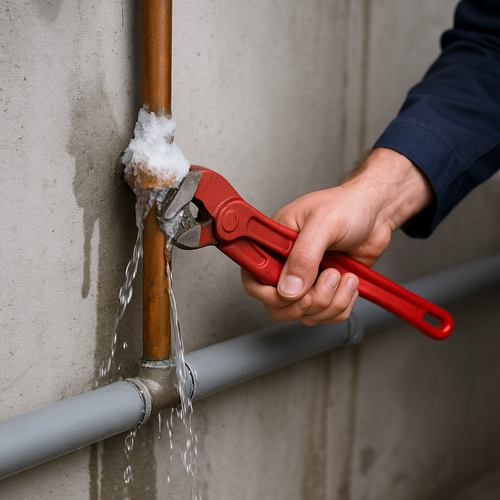
Shut off the main water valve immediately if a frozen pipe shows any sign of bulging, cracking, or already leaking, since a frozen line under pressure can burst without warning, based on guidance from the American Red Cross on winter storm home safety.
If the line hasn't burst yet, you can try gently thawing it with a hair dryer, warm towels, or a space heater kept a safe distance away — never with an open flame. Leave the faucet on that section open so melting ice has somewhere to go. If you can't locate the frozen section, or the pipe has already split, that's a job for frozen pipe repair rather than trial and error.
A burst pipe on a Saturday afternoon or overnight is stressful, but the fix is the same either way: get the water shut off at the main, then call. We work Monday through Saturday, 8am to 5pm, and quote every frozen or burst pipe repair as one flat price before we start.
When Should Arkansas Homeowners Start Winterizing?
Late September through October is the right window to winterize in Arkansas, well before the state's first typical hard freeze, which the National Weather Service generally places in mid-to-late November for the Hot Springs area, though earlier cold snaps do happen.
Doing this work early means it's finished before the scramble that hits every hardware store once the first freeze warning goes out. It also gives you time to notice problems — a valve that won't turn, insulation that's already deteriorating — while there's no pressure and no cold weather to work around.
Getting Ready Before the First Freeze
Winterizing pipes in Arkansas isn't about heavy-duty prep — it's about handling a short list of small, specific tasks before the temperature drops instead of after. Insulate what's exposed, drain and cover outdoor spigots, know your shutoff, and keep an eye on the forecast once winter sets in.
If you'd rather have someone walk the property and flag the risk spots before the cold hits, or if a pipe has already frozen or burst, get in touch or call (501) 318-3747. We serve Hot Springs, Hot Springs Village, Malvern, Bismarck, Jessieville, Pearcy, and Royal, and every job gets one flat, up-front price before we start.