The short answer
- Recurring leaks in different spots, low pressure at every fixture, and rusty or discolored water are the three clearest signs a home needs whole-house repiping rather than another patch repair.
- Homes with original galvanized pipe (common in houses built before the 1970s) or polybutylene pipe (common from the mid-1980s to mid-1990s) are the most likely candidates in the Hot Springs area.
- Most residential repipes take 3–5 days, done in stages so water stays available for at least part of each day.
- Bowen Plumbing quotes whole-house repiping as one flat, up-front price before any wall is opened — never billed hourly.
Fix one leak and another shows up three months later somewhere else in the house. At some point that pattern stops being bad luck and starts being a pipe system that's simply worn out. For homeowners looking into whole-house repiping in Hot Springs, the hard part usually isn't deciding to fix it — it's knowing when patching has actually stopped making sense.
Bowen Plumbing has been family-owned and operated in Hot Springs for 41 years, and we've repiped homes in nearly every neighborhood in town. Below are the warning signs we actually look for, an honest timeline for the work, what living through it looks like, and what drives the cost.
How Do You Know If Your House Needs Repiping?
A home needs whole-house repiping when leaks keep recurring in different locations, water pressure has dropped at every fixture (not just one), or water runs discolored throughout the house — especially in homes with original galvanized or polybutylene pipe. One or two of these together is a strong signal, not a coincidence.
Recurring leaks in different spots
One leak is a leak. A leak under the kitchen sink last spring, a pinhole leak in the hallway wall this winter, and a slow drip behind the water heater now is a pattern. Galvanized and old copper pipe corrode from the inside out, and once one section starts failing, nearby sections usually aren't far behind.
Low water pressure at every fixture
Low pressure at one shower is usually a clogged aerator or a bad valve — a quick fix. Low pressure at every faucet and shower in the house points to corrosion narrowing the pipes themselves from the inside, which no amount of cleaning a single fixture will solve.
Discolored or rusty water
Rust-colored water, especially right after the water's been off for a while, usually means galvanized pipe is corroding internally. It's not just unsightly — it's a sign the pipe wall is thinning from the inside and getting closer to failure.
Pipe material and age
In the Hot Springs area, two pipe types account for most of the repiping calls we get. Galvanized steel pipe, common in homes built before the 1970s, has a typical service life of 40–50 years and is often already past it. Polybutylene pipe, installed widely from the mid-1980s through the mid-1990s, is prone to brittle failure and is no longer used in new construction.
How Long Does Whole-House Repiping Take?
Most residential whole-house repipes in Hot Springs take 3 to 5 working days, depending on the home's size, number of stories, and how the original plumbing was routed. A single-story home with accessible crawlspace access typically finishes faster than a two-story home on a slab.
We plan the work in stages rather than shutting off water to the whole house for days at a stretch. Day one is usually running new supply lines through the attic or crawlspace and opening the wall sections needed to connect fixtures. By the middle of the job, most of the house has water again while we finish the remaining connections.
- Day 1–2: New lines run through attic/crawlspace, initial wall openings, rough-in connections
- Day 2–3: Fixture connections completed, water restored to most of the house
- Day 3–4: Remaining connections, drywall patch prep, walkthrough
- Day 4–5 (larger homes): Final testing, pressure checks, cleanup
You'll be without water for stretches during the day, but not for the entire job. We tell you exactly which days and which parts of the house will be affected before we start, so there are no surprises mid-week.
What Does It Actually Look Like to Live Through a Repipe?
Living through a whole-house repipe means several days of some wall openings, brief water shutoffs during work hours, and a crew in and out of the house — most homeowners find it manageable, not disruptive to daily life once they know what's coming. It is not comparable to a full remodel.
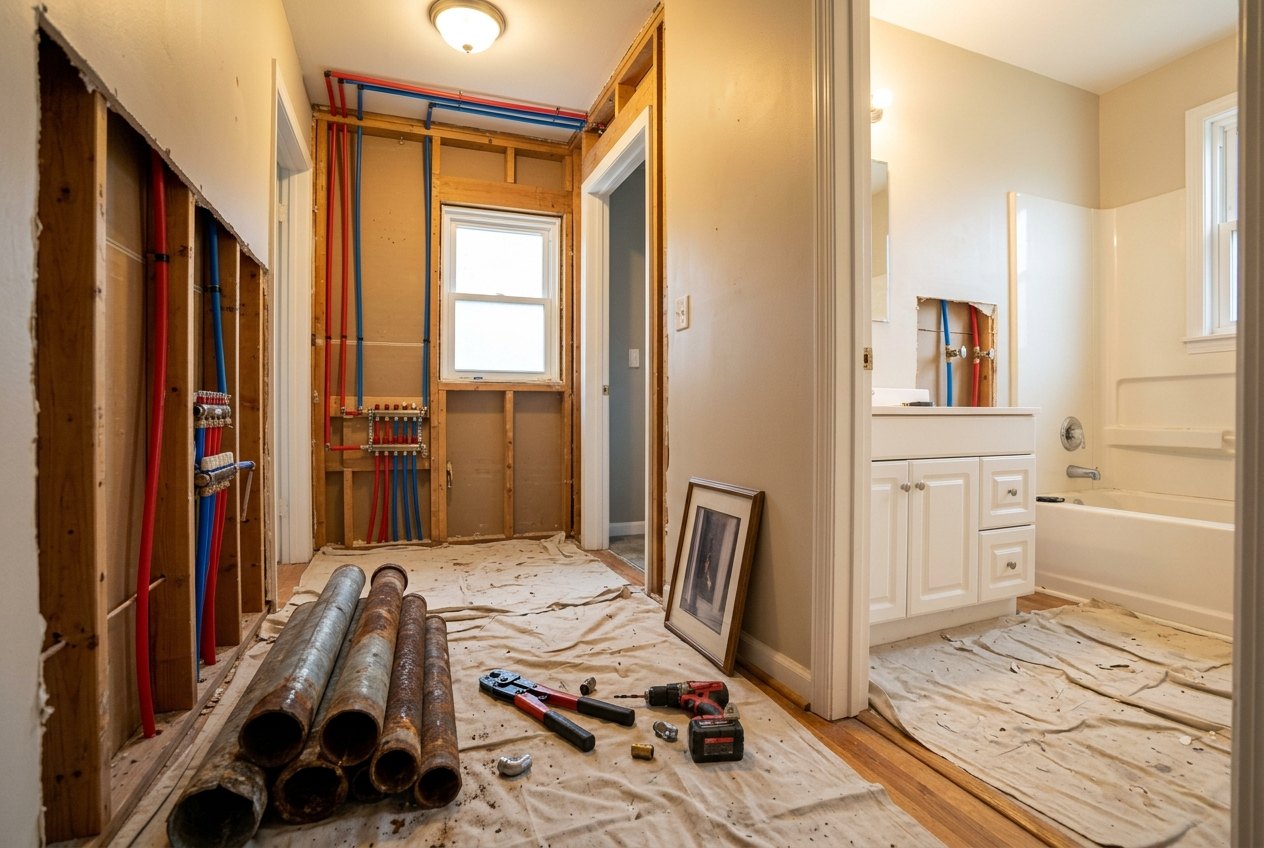
Here's the honest version: we open small, targeted sections of drywall — not entire walls — to reach the old pipe runs, usually near where pipes drop down to fixtures. PEX, the material we use most often, needs far fewer openings than a copper repipe would, because it can be run in longer continuous sections without as many joints.
During work hours, expect water to be off in sections of the house while we're actively cutting over a line, then back on once that section is connected. Most homeowners keep living in the house through the whole job — you don't need to plan on staying elsewhere.
Drywall repair after a repipe is typically limited to patching the openings we made, not repainting or re-texturing entire rooms. We coordinate that as part of the project so you're not left with holes in the wall when we leave. We also protect flooring and furniture near the work area and clean up debris at the end of each day, not just at the end of the job.
What Determines the Cost of Whole-House Repiping in Hot Springs?
Whole-house repiping cost in the Hot Springs market depends mainly on home size, number of stories, pipe material chosen, and how much drywall or flooring has to be opened to reach existing runs. A single-story home on a crawlspace with easy attic access generally costs less than a two-story home on a slab foundation.
Home size and layout
More fixtures and more square footage mean more linear feet of pipe and more connection points, which adds labor time regardless of pipe material chosen.
Copper vs. PEX
Copper is time-tested and durable, but it costs more in materials and typically requires more wall access to install. PEX is flexible, resists freezing better, and usually installs with fewer wall openings — which is why most Hot Springs repipes we do now use it.
Foundation type and access
Homes with a crawlspace or accessible attic are usually faster and less invasive to repipe than homes on a slab, where some lines may need to be rerouted through walls or ceilings instead of run underneath the house.
Every one of those factors gets accounted for in a single number — not an hourly estimate that can grow once we're inside the walls. We walk the home, look at what's actually there, and give you one flat, up-front price before any work begins.
Is Repiping Worth It, or Should You Just Keep Patching?
For a home with one isolated leak, patching is the right call — a full repipe would be overkill. For a home with recurring leaks in different locations, house-wide low pressure, or discolored water tied to galvanized or polybutylene pipe, repiping usually costs less over a few years than repeated emergency patch repairs plus the water damage they cause.
We don't push a repipe on every older home that calls us. If a targeted leak detection visit shows the problem is contained to one section, we'll tell you that and fix just that section. The recommendation follows what we actually find, not the other way around.
Getting a Straight Number on Repiping Your Home
If your Hot Springs home has had more than one pipe leak in the past year, pressure that's dropped everywhere, or water that runs cloudy or rust-tinted, it's worth having someone take an honest look before the next leak turns into water damage.
Get in touch or call (501) 318-3747 and we'll walk the house, tell you straight whether it needs a full repipe or a targeted repair, and give you one flat price before any work starts.