The short answer
- Tankless units cost more upfront ($2,000–$4,500 installed) than tank units ($900–$2,000), but typically last 15–20 years versus 10–12 for a tank.
- Garland County's hard water can scale up a tankless heat exchanger faster than a tank unit, so annual descaling isn't optional — it's the maintenance that protects the investment.
- Tankless makes the most sense for larger households or homes doing a full renovation; a straight tank swap is often the more practical call for a like-for-like replacement.
- Neither option is automatically the 'better' choice — the right one depends on household size, existing plumbing, water quality, and budget.
Homeowners researching a water heater replacement almost always end up asking the same question: tankless or tank? Both heat water reliably. The honest answer is that neither one is universally better — it depends on your household, your existing plumbing, and how much you're willing to spend upfront versus over time.
Bowen Plumbing has installed both types across Hot Springs and the surrounding area for 41 years as a family-owned company. We're not going to push you toward the pricier option just because it's newer technology. Here's what actually differs between the two, including the one factor a lot of tankless sales pitches leave out: Garland County's hard water.
What's the Real Difference Between Tankless and Tank Water Heaters?
A tank water heater stores 30–80 gallons of hot water and keeps it heated around the clock, ready when you need it. A tankless unit heats water on demand as it flows through, with no storage tank at all — according to the U.S. Department of Energy, tankless units can be 24%–34% more energy efficient in homes using less than 41 gallons of hot water daily.
That efficiency gap narrows as household hot water use increases, dropping to about 8%–14% savings in homes using around 86 gallons a day. In practical terms: a smaller household sees a bigger efficiency benefit from going tankless than a large family running multiple showers and a dishwasher back to back.
How Do Upfront Cost and Lifespan Compare?
A tank water heater typically runs $900–$2,000 installed, while a tankless water heater installation runs $2,000–$4,500 — roughly double, largely due to the unit itself and often the need for upgraded gas or electrical lines. Lifespan tells the other half of the story: tank units last 10–12 years, tankless units 15–20 with proper maintenance.
| Factor | Tank Water Heater | Tankless Water Heater |
|---|---|---|
| Installed cost | $900–$2,000 | $2,000–$4,500 |
| Typical lifespan | 10–12 years | 15–20 years |
| Energy efficiency | Standard | 8%–34% more efficient (DOE) |
| Hot water supply | Limited by tank size | Continuous, on demand |
| Install complexity | Usually straightforward swap | May need gas/electrical upgrades |
| Hard water sensitivity | Moderate — sediment buildup | High — scale coats heat exchanger |
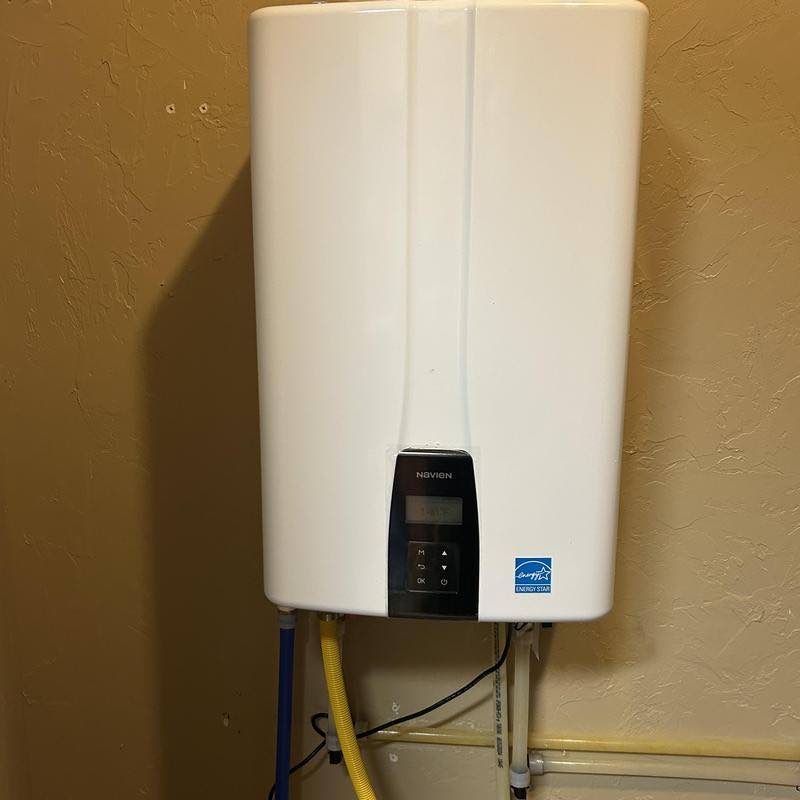
| Space required | Larger footprint (closet/utility area) | Compact, wall-mounted |
Run the math over the full lifespan rather than the sticker price. A tankless unit costs more to install but tends to need replacing less often, so the gap shrinks — sometimes closes entirely — once you account for two tank replacements against one tankless unit over the same 20 years.
Is Installing a Tankless Water Heater More Complicated?
Swapping a tank for another tank is usually a same-day, drop-in replacement using the existing connections. Installing a tankless unit for the first time often means upgrading the gas line, adding a dedicated electrical circuit, or running new venting — work that adds both cost and time to the job.
If your home already has a tankless unit and just needs a replacement, that install complexity mostly goes away, since the gas line, venting and mounting are already in place. First-time tankless installs are where the extra labor and materials show up on the quote.
How Does Hard Water Affect a Tankless System in Hot Springs?
This is the part a lot of homeowners don't hear until after installation. Garland County water runs moderately hard, and mineral deposits build up inside a tankless unit's narrow heat exchanger passages far faster than inside a tank's open storage space, gradually restricting flow and reducing efficiency.
A tank water heater tolerates hard water reasonably well — sediment settles at the bottom and an annual flush clears most of it out. A tankless unit is less forgiving. Scale builds inside narrow internal passages, and without regular descaling it can shorten the unit's lifespan well below its 15–20 year potential, sometimes triggering error codes or reduced flow within just a few years.
Which Water Heater Fits Your Household Size?
Household size and hot water habits usually decide this faster than any efficiency chart. A single tankless unit sized correctly can supply continuous hot water to a family running showers, laundry and dishes at once — a tank runs out and needs time to reheat.
Tank water heaters tend to fit better when:
- You're doing a like-for-like replacement and want to avoid extra install work
- Budget upfront matters more than long-term efficiency
- Your home doesn't already have the gas or electrical capacity for tankless
- You want a simpler system with fewer moving parts to maintain
Tankless water heaters tend to fit better when:
- You're renovating and open to upgrading gas/electrical anyway
- Your household regularly runs multiple hot water fixtures at once
- You're planning to stay in the home long enough to benefit from the longer lifespan
- You're willing to commit to annual descaling maintenance
Should You Choose Tankless or Tank?
There's no single right answer here, and any plumber telling you tankless is always worth it isn't giving you the full picture. A large family replacing a failed tank on a budget is often better served by another tank. A homeowner remodeling a bathroom and planning to stay put for 15+ years may get real value from tankless.
We walk through both options with you before recommending anything, and the number we quote — for either system — is the flat, up-front price you'll pay, with no hourly billing and nothing added once the work starts.
Getting the Right Water Heater for Your Home
Tankless and tank water heaters both do the job well; the right pick comes down to your household's hot water use, your home's existing gas and electrical setup, and how you weigh upfront cost against long-term lifespan. Garland County's hard water is a real factor for tankless owners, not a footnote.
If you're weighing a water heater replacement or a first tankless installation in Hot Springs, Hot Springs Village, Malvern, Bismarck, Jessieville, Pearcy or Royal, get in touch or call (501) 318-3747 and we'll walk the tradeoffs with you before quoting a flat price.